
Reporter reads the patent itself, works out where the art would live, searches patent classes and scientific libraries together, and grades everything it finds against the claim. Every reference is retrieved, dated and quoted — none is recalled from a model's memory.
Not a filter bolted onto the output. An architecture that makes an unsupported statement structurally unable to reach the report, enforced at both ends of the workflow.
What you get: the reference in your report is a reference you can click, and the sentence about it is one the source actually supports.
Every classification search ends where the examiner ended. Mapping a scientific library's own taxonomy onto the patent classification system is how the search gets past that boundary.
Thousands of real patents that cite a library's papers are harvested through the citation graph, and their classification codes counted topic by topic. The mapping is the citation record of the field, not a keyword list.
Candidate codes the examiner never assigned arrive each with its measured evidence and its official definition. Broadenings that cannot hold a find are left off. You uncheck what does not fit.
A patent that belongs to two domains at once — a medical device whose heart is photonics — is measured against both taxonomies and searched in both, with the evidence on screen.
A code already on your patent's face, already among your IPCR codes, or already in the references you cited is not counted as a find. The number you see is what the map added, not what it restated.
The highest-rated document of the entire study was an application filed four years before the subject's priority date.
It sat under a classification code the examiner never assigned to the subject. Without the map, that document does not exist for you.
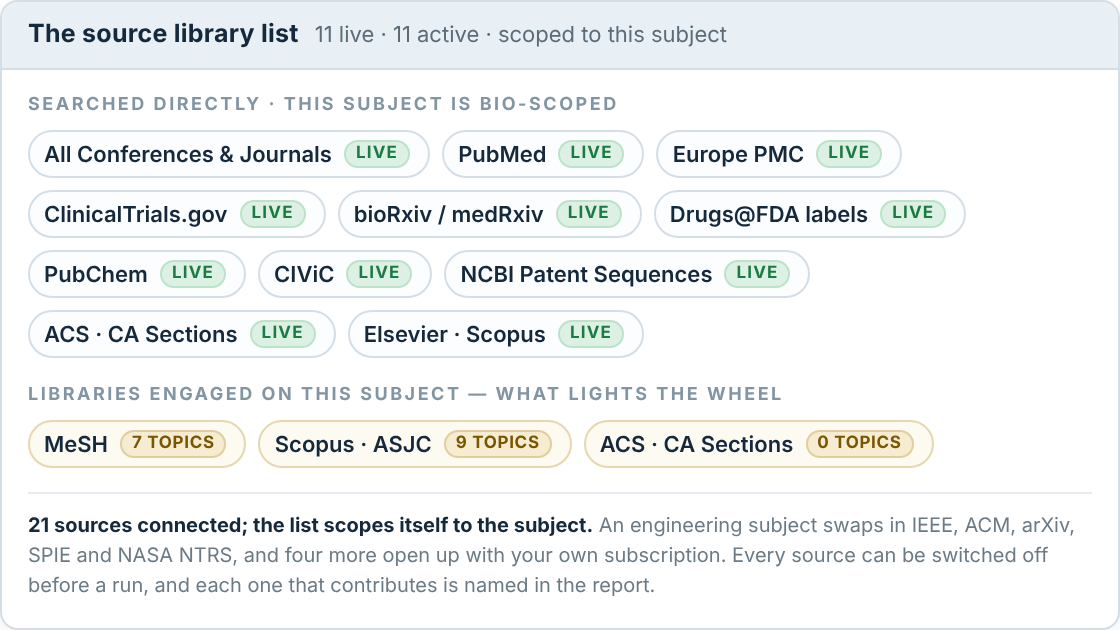
Nothing in the method is specific to one field: any rich library with a taxonomy of its own can be mapped the same way.
Reads the patent's own claims, description and abstract, and extracts the classes an examiner would use.
The search starts from your invention, not your keywords.
Boolean lines, thresholds, preview and curation — all before anything is committed to.
You run the search; it does not run you.
Library taxonomies mapped onto patent classification through the citation record, with the evidence shown.
Art that a classification-bounded search cannot reach.
Five agents search journals, proceedings and standards; every hit is re-checked against bibliographic engines.
Non-patent art you can put in a filing.
Chinese, Japanese, Korean, German and more, screened and ranked by the same measurement, then translated in full and attested.
Searchable becomes citable; citable becomes presentable.
A ledger of every piece of the claim, automatic cycles that widen and re-grade, and the combination assembled.
An obviousness case built on dated, verbatim evidence.
Also in Reporter: current-awareness monitoring of a live asset, portfolio and landscape modes, and run notifications when a long analysis finishes or is recovered.
Gap-Hunter assembles the evidence for all three — as measured analysis, never as legal advice — and finishes with an independent council checking the work.
The claim is cut into its pieces and held in a ledger. Cycles widen the search into classes the examiner never assigned and into every library, grade what comes back against each piece, and redraw the ledger.
The problem addressed, with every reason anchored to a verified quote — and supporting and weakening evidence set out separately, so an objection is documented rather than buried.
Each member of the combination checked against the priority date, each passage quoted verbatim, and every piece closed by a find, closed by analogy with your confirmation, or shown honestly as open.
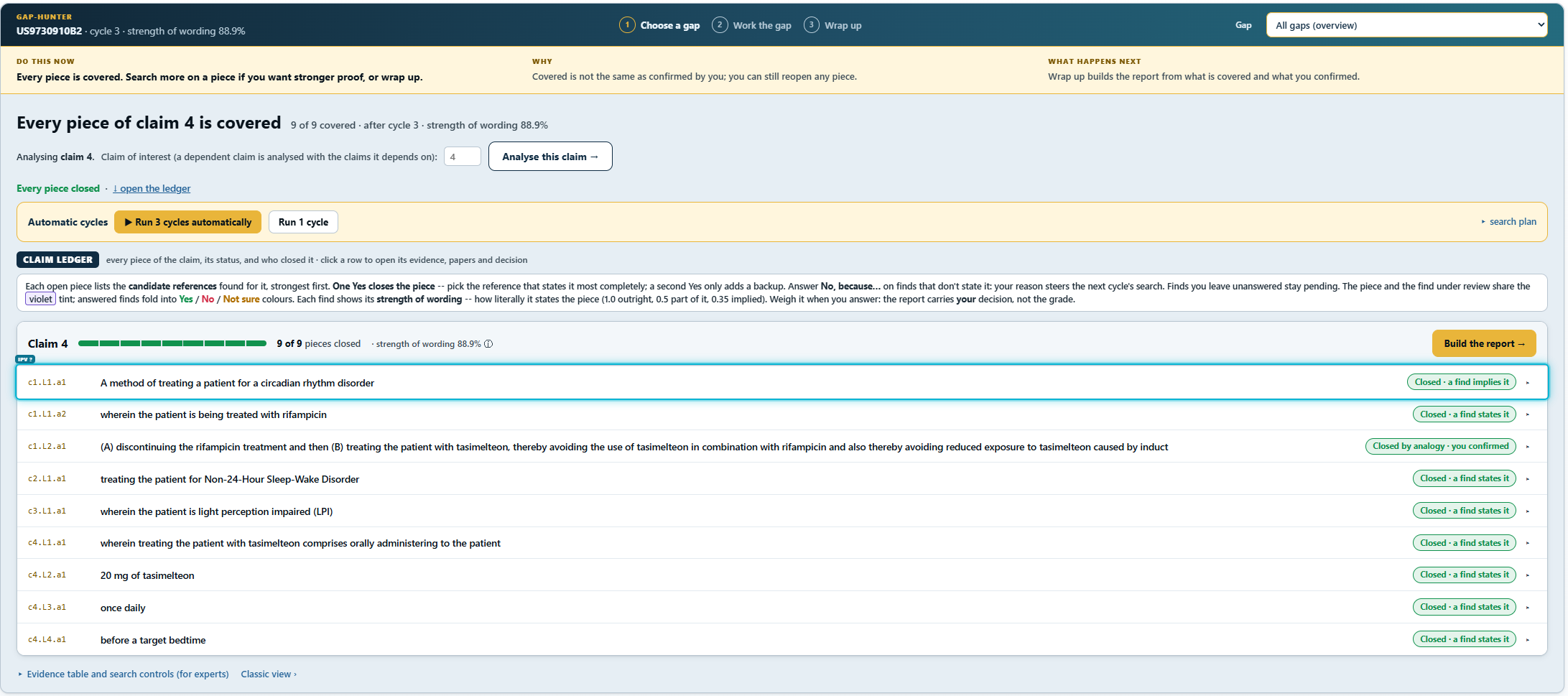
A cycle is one full pass at the pieces still open. It is not a repeat of the same search with a bigger number attached.
Only limitations that nothing has yet stated. Closed pieces are left alone, so each cycle is cheaper and more targeted than the one before.
New classification lanes are added from the citation-measured map, and scientific libraries are searched alongside the patent record. On the run documented here, three drug-formulation lanes were added at the fourth cycle.
Candidates are retrieved in full where the full text can be reached, and anything published on or after the priority date is dropped before grading.
Each surviving document is scored limitation by limitation, with the passage that earned the grade attached to it, and a strength of wording from outright to implied.
Pieces that a find now states are closed. Pieces that moved but did not close show their best candidate and wait for a human answer. Nothing closes without one.
For any piece, “where we looked” lists every place the cycles searched. A cycle that returns nothing has still ruled territory out, and that is part of the record.
The token goes round once per cycle. Lanes are added at widen, finds appear at grade, and the ledger closes at redraw.
Figures from the US9730910B2 run documented in Evidence. Cycle times were 49, 22, 22 and 21 minutes.
The architecture does not chase the industry; it absorbs it. New models drop in as they ship, from any vendor, under your keys and your terms. New libraries — any specialty library with a taxonomy of its own — become another mapped domain: their taxonomy, our measurement. New sources plug into the same verified pipeline, with the same grading and the same receipts. New validators join the cascade, and new roles can join the council, without changing the chain of custody.
That is why the extensible domain matters more than any single field we have mapped. A firm whose work sits in materials science, or agriculture, or semiconductors is not waiting for us to build a product for them. Their library is mapped the same way this one was.
Technology this capable should make expertise go further, not replace it.
Jon Karlin, Founder